
Unusual hotels in Paris: the guide to unique places to stay
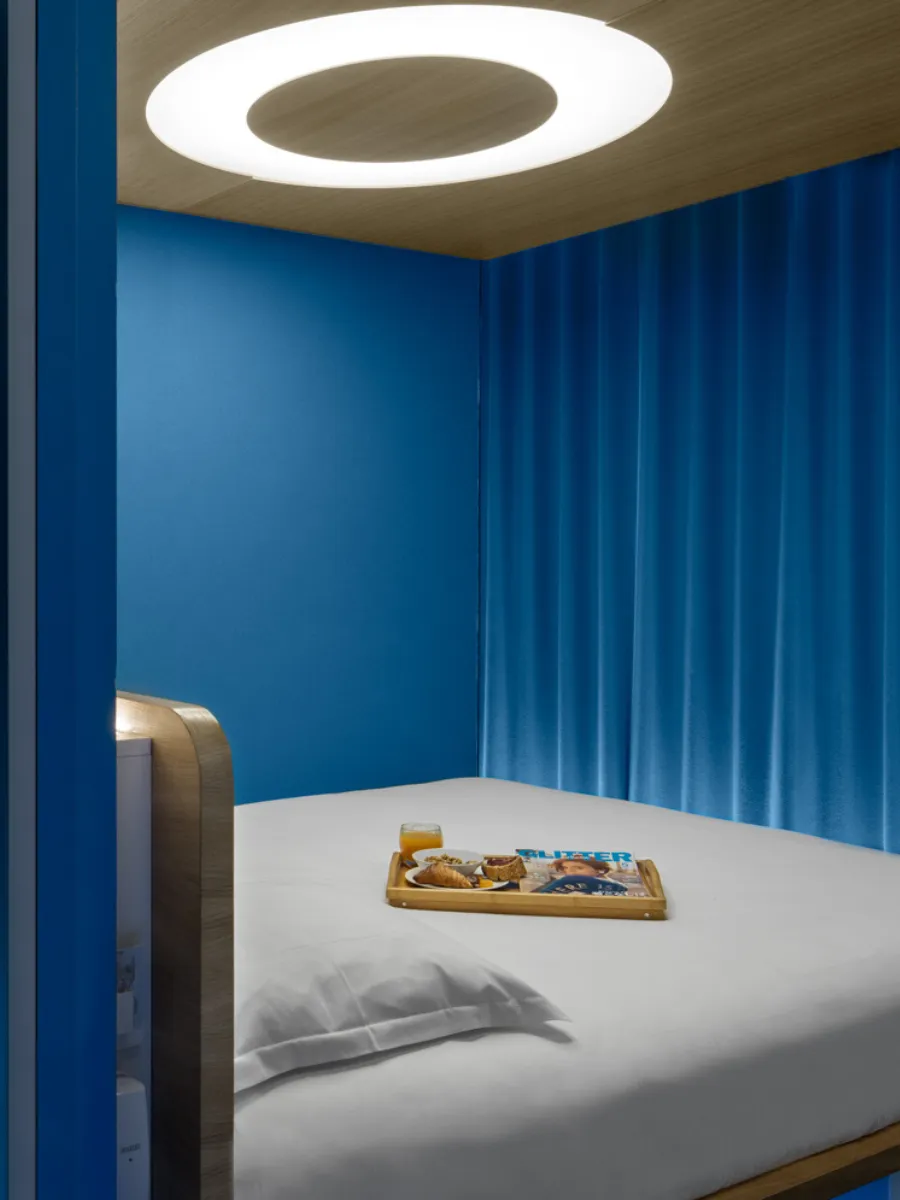
"Unique hotel" is a convenient label that covers just about everything: a houseboat moored on the Seine, a converted former printing house, a room decorated like a sleeper train carriage, or an establishment where the architect simply took some risks. Here is a look at what truly constitutes an unusual format in Paris, what each one means for your stay, and how to choose based on the duration and purpose of your trip.
What sets a truly unique hotel apart
In our view, three criteria distinguish an unconventional hotel from one that is simply well-decorated.
The structure. The establishment occupies a space not originally built for hospitality: a factory, a convent, a houseboat, or a residential building. Structural constraints create volumes that no new-build hotel would ever have designed.
The room format. The room deviates from the standard: in terms of surface area, layout, relationship to the bed, and furniture integration. This is the case with capsule hotels.
A clear creative vision. An architect or designer has imposed a cohesive signature on the entire property, rather than a decorator simply dressing up existing rooms. A hotel that meets none of these three points is a good hotel, but not an unconventional one.
Capsule hotels: the most misunderstood format
The term originates from Japan. In the late 1970s, the capsule hotels in Tokyo and Osaka offered stacked bunks in large dormitories, without private bathrooms, for employees who had missed the last train. This is the image that remains attached to the word, and it is what leads to misconceptions today.
In France, the term means something else. A capsule room is a complete private room: with a bathroom, window, air conditioning, and a door, where every centimeter has been designed to avoid wasted space. Furniture, lighting, and storage are integrated into the architecture rather than added to it. You gain in usable space what you lose in square footage.
The difference is tangible. In a standard 13 m² room, a wardrobe, desk, and nightstand placed on the floor eat up three to four square meters of circulation space. In a capsule of the same size, these functions are built-in: the space available for moving around is significantly greater.
Why this format makes sense in Paris. The center of the capital is built with old buildings that have constrained volumes, are often listed, and are rarely modifiable. A hotel that wants to remain hyper-central must contend with small rooms. The capsule approach embraces this constraint and turns it into a design project, rather than suffering through it apologetically.
Converted buildings
Paris has several hotels housed in places that were not intended for such use: former convents, private mansions, printing houses, schools, and industrial buildings in the northeast of the city.
The benefits: high ceilings, exposed beams, interior courtyards, and sometimes a garden—features that no new construction can replicate.
The potential drawbacks: inconsistent soundproofing between rooms, complex layouts, and highly varied room types within the same property. At these hotels, the specific room category you book matters more than elsewhere.
Floating accommodations
Converted barges and boat hotels moored on the Seine or along the canals. The most spectacular format, and also the most restrictive.
Good to know before booking: cabins are narrow, ceilings are low, the sound of water and river traffic is constant, and access is almost never suitable for guests with reduced mobility or heavy luggage. Excellent for one or two nights, rarely longer.
Design hotels
Here, it is not the building that is unusual, but the perspective applied to it. An architect or designer oversees the entire project—rooms, hallways, bar, and furniture—imposing a cohesive design language.
Consistency is what sets these hotels apart from a "design" hotel in the marketing sense. When a single vision guides the entire design, it shows in the details: the door handles, the lighting, and the way a bathroom opens into the bedroom.
How to choose based on your stay
One or two nights, as a couple. All formats work well. This is the time to try a barge or a capsule hotel, where space constraints are less noticeable.
Three nights or more. Prioritize space and quiet: choose a converted building, a superior room, or a suite. A compact room is easier to handle during a short stay.
With family. Check actual capacity first. Many unique hotels in the city center do not accommodate more than two people per room.
On a business trip. Centrality and connection quality come first. A central capsule hotel beats a spacious hotel on the outskirts as long as your meetings are within Paris proper.
A first visit to Paris. Choose the location before the format. The time saved on commuting is worth more than ten square meters of extra space.
Hôtel Odyssey, a design capsule hotel in the 1st arrondissement
Hôtel Odyssey is the only design capsule hotel in the heart of Paris. Its 29 rooms were entirely conceived by designer Ora-Ïto, each featuring a different chromatic tone: 29 rooms, 29 colors, no two alike.
Three room types, ranging from 12 to 19 m²: the Cocoon overlooking the courtyard, the Odyssey facing the street with its Corian bathroom separated by gradient glass, and the Galileo, the most spacious, featuring an alcove bed. All rooms include a private bathroom with a rainfall shower, air conditioning, and free Wi-Fi.
The hotel is a 3-star establishment with the EU Ecolabel certification, located at 19 rue Hérold in the 1st arrondissement, a 10-minute walk from the Louvre and 6 minutes from Châtelet-Les Halles.
More articles
FAQ
No. In France, a capsule room is a complete private room, including a bathroom, window, and air conditioning. The term refers to a design choice focused on space optimization, not a shared accommodation model.
Generally between 9 and 20 m². At Hôtel Odyssey, rooms range from 12 to 19 m².
Not necessarily. Compact formats are often more affordable than rooms of equivalent size in the same neighborhood, precisely because they embrace space constraints.
Yes, provided you choose the right room type. For stays longer than 3 nights, we recommend booking the property's most spacious category.
The 1st, 2nd, and 3rd arrondissements are home to most of the city center's unique properties, thanks to their historic architecture.